Friday, August 17, 2018

The Grave Yard Tour: Welcome to Acadie!


Alan Melanson (top right) tells tales in the Garrison Graveyard, Annapolis Royal,  Nova Scotia.

We have been told by fellow travelers not to miss the night time graveyard tour of Annapolis that is given by a local historian. We meet at the Fort at dusk greeted by Mssr. Alan Melanson. He hands us a lantern lit by a candle and asks us where we are from.  

"California.... San Francisco."  
"California?  Why are you traveling here?", he wonders. 
"My ancestors came from this town", I tell him.  
"British or Acadians?" he queries.  
I reply with a list of family names, "Hebert, Cormier, Michaud, LeBlancs" . 
"Welcome, fellow Acadian, he beams.   "Did you know that there are 3 million of us scattered around the world? "

People drift in as the sky darkens. A group of about 20 people assembles around Mr. Melanson who is dressed in a black mourning coat and top hat. He has the face of a character actor, the French accent of an Acadian, and the assurance of someone who has given this tour many times.  We we follow him across the grassy hills into the dim, graveyard around the fort. We climb stairs. He cautions us not to trip on the small foot stones (these are paired with head stones.) Good God!, it is dark in this graveyard. 

As we go Alan tells a series of stories of the people now underground. Buried in the Garrison Graveyard are many, but only a few have markers.  He tells us stories of English soldiers, Scots traders, Micmac first people, African free people, and of the Acadian French colonists. He gives us the recipe for Moose Nose Soup. He describes us how the widows of soldiers in the fort where thrown onto the street unless they married another soldier within the week.    We learn to say SHAM plan (Champlain) and Ah ca DEE (Acadia) He tells us the story Acadian deportation in 1755 when his and every French Acadian was banished from their homeland.  He tells us a little about his own history and how some of his deported relatives mutinied, stole the transport boat from their captors and sailed for Quebec. 

Mr. Melanson is an accomplished historian and a charismatic story teller. By the end of the tour I am feeling proud to be an Acadian. Strange what an evening stumbling around a graveyard in the dark can accomplish.

Another account of the graveyard walk:
https://www.mainewriter.com/articles/Graveyard-Tour.htm

Friday, August 10, 2018

Port Royal: Ancestral Home


Evening on the Rivier Dauphine renamed by the British as Annapolis River. Here, rock stacks grace the shore.


Ahh… So this is where the first ancestors lived.  I am standing on the bay shoreline at Port Royal (now Annapolis Royal).  I feel myself sink into a one of those time warp, magical moments.  It is deeply quiet. The river is wide here, becoming a bay. The strong tidal sway is silent as the Annapolis River widens and travels out   to the sea.  It is a small town with a big history. Boats are still being built on the shore. Standing on the wharf, time seems to have stopped.  

My ancestors looked at this water. Built their
homes on this shore from these forests. Caught the fish in this water. I feel a deep sense of connection. I remember the novel Siddartha and the river of life running through generations. The flow, always the same, always new. 

The French first arrived at this river place which they called Port Royal in 1605 fourteen years before the Pilgrims parked the Mayflower at Plymouth Rock. They chose this spot because of its the deep, sheltered harbor.  These qualities along with the fertile river valley made Port Royal  a prize location. The town changed flags more than half a dozen times in battles between the French and the British colonials.  


We have been told by fellow travelers not to miss the night time graveyard tour of Annapolis that is given by a local historian. We meet at the Fort at dusk by Mssr. Alan Melanson hands each of us a us a lantern with a lit candle and asks us where we are from. California? Why are you traveling here? My ancestors came from this town? Acadians?  I tell him yes...Hebert, Michaud, LeBlancs, Bruns … Welcome, fellow Acadian. Did you know that there are 3 million of us scattered around the world? 

The group of about 20 people assembles around Mr, M who is dressed in a black mourning coat. He has the face of a character actor and the French accent of an Acadian. We learn to say SHAM plan (Champlain) and Ah ca DEE (Acadia) He tells us the story of the Acadian flag. We we follow him across the grassy hills into the dark, unmarked graveyard around the fort. He  tells a series of stories of the lives of the people now underground. Buried in the Garrison Graveyard are many. But only a few have markers.  He tells us stories of  English. Scots, Micmac, Africans, and of the Acadian French, expelled from these lands. …. He gives us the recipe for Moose Nose Soup. He describes us how the widows of the fort where thrown onto the street unless they married another soldier.   He is a charismatic and a very excellent story teller. 

Another account of the graveyard walk:
https://www.mainewriter.com/articles/Graveyard-Tour.htm

Sunday, August 5, 2018

Canada Here We Come


Buckled into the flight on Air Canada I hear French. Really? We are on the runway at SFO poised to travel to Nova Scotia. Wow.  EVERY  message is given in French and English on Air Canada.  Exit/Sortie.  Delayed/ retardé  Refreshment/ rafraichissement    My god, Canada IS BILINGUAL.

I strain to pick out the words that I can understand. The cheerful music of the spoken French feels oddly familiar, as if I am recalling a dream. Ahh…Now I remember, this is the language I heard as a toddler. My grandmother Lillian Dionne spoke this lilting French.   My mother Marie answered her in French.  Mon Dieu!   French feels both foreign and familiar. 

I wonder if it takes twice as long to do anything in Canada because all communications must be  translated... given in  English and French.  Along the way we discover that Canada seems to be slower. At least the Canada of the Maritimes. People are friendly. They take time to talk. They are surprised to learn we are from California. Really?  The Bay Area, isn’t that near Oakland…where there are so many murders? They all know Oakland.  So many guns. Canadians see our country as extremely dangerous. Some mention that they are not traveling in the US… not while Trump is president. We agree. We are not in traveling America. We are in Canada.

This excursion to an ancestral home is to celebrate my 70th birthday. Traveling is how I like to spend time. New flavors, exploring new territory, discovering new things vs. hostessing around a noisy table eating a lot of desserts that I don’t need. The plan was roughly to hit the beauty spots of the Maritimes and Quebec. I am hoping to see the towns that held personal history for my family tree.  Port Royal, Minas, Beaubassin, Grand Pre, Riviere Canard… then onto the Quebec’s Saint Lawrence river towns:Trois Riviere, Cacouna, Isle Royal. 

Tuesday, March 8, 2016

Our Girl from Kankakee: Lillian Zoa Dionne Maltos

Lillian Zoa Dionne Maltos 1881 - 1957


Lillian Z. Dionne Maltos was tall, dignified and was given to scolding outbursts in French. Every Sunday I remember her wearing hats and gloves to church. She favored floral print dresses and did not put up with nonsense. I recall my mother, Marie Ida Maltos Allison, asking her to speak english when her french came fast and furious.  I didn't care what she spoke, because when I first met her I didn't speak anything.  I was zero and Lillian was in her late sixties. Perhaps that was why she seemed so tall. 

My last memories of grand mama Lillian are the impressions of a toddler. She was a widow who's latino husband Jack Maltos had died in northern California about two decades before. Lillian lived with my family for a number of years and then moved to Utah in the 1950"s to live with her younger daughter, Juanita Maltos Rogers.   After she moved, I never saw her again.   

What I knew about the history of Lillian Z. came mostly from the memories of my mother Marie.  I knew Lillian Dionne was French Canadian.  I also knew she was from Kankakee, Illinois.  As a kid, I could hold these conflicting facts in my mind. No problem.   I knew she came from a big family. I was told she was related to the Dionne Quintuplets. (I had no idea what a quintuplet was.) Lillian had sisters and cousins in Los Angeles.  

Sometimes mom packed up us little girls and we visited this clan of Dionnes and Lamberts in LA. These visits required a small girl to be on best behavior for a couple of days.  I was deeply bored as I squirmed in Aunt Stella's (Lillian's sister's) formal living room with a black grand piano with a bunch of relatives in their church clothes after a long, tedious Sunday lunch.  

I decided then and there I didn't like French Canadians much. Clearly they were too dull for words. Why would anyone spend five minutes with them? They have been last on the Allison sisters genealogical list to explore.   

I was wrong. Very wrong.

Pulling the threads on Lillian Dionne's tree has revealed an amazing, deep history of the French in the Americas. She is from a lineage that includes Quebecois from a very early era, as well as some of the first families of Port Royal in the Acadian Canadian maritime provinces. Some of her Canadian ancestors became Cajun families that found their way to Louisiana after they were exiled from Acadia by the British in 1755.

Grandmama Lillian Zoa Dionne b.1881 has opened the door and connected us to a world of history we didn't know was there. Discovering French Canada has been fascinating and fun.   

Merci Lillian Z! 

Sunday, November 8, 2015

Lost Boys? : Juan and Antonio Maltos


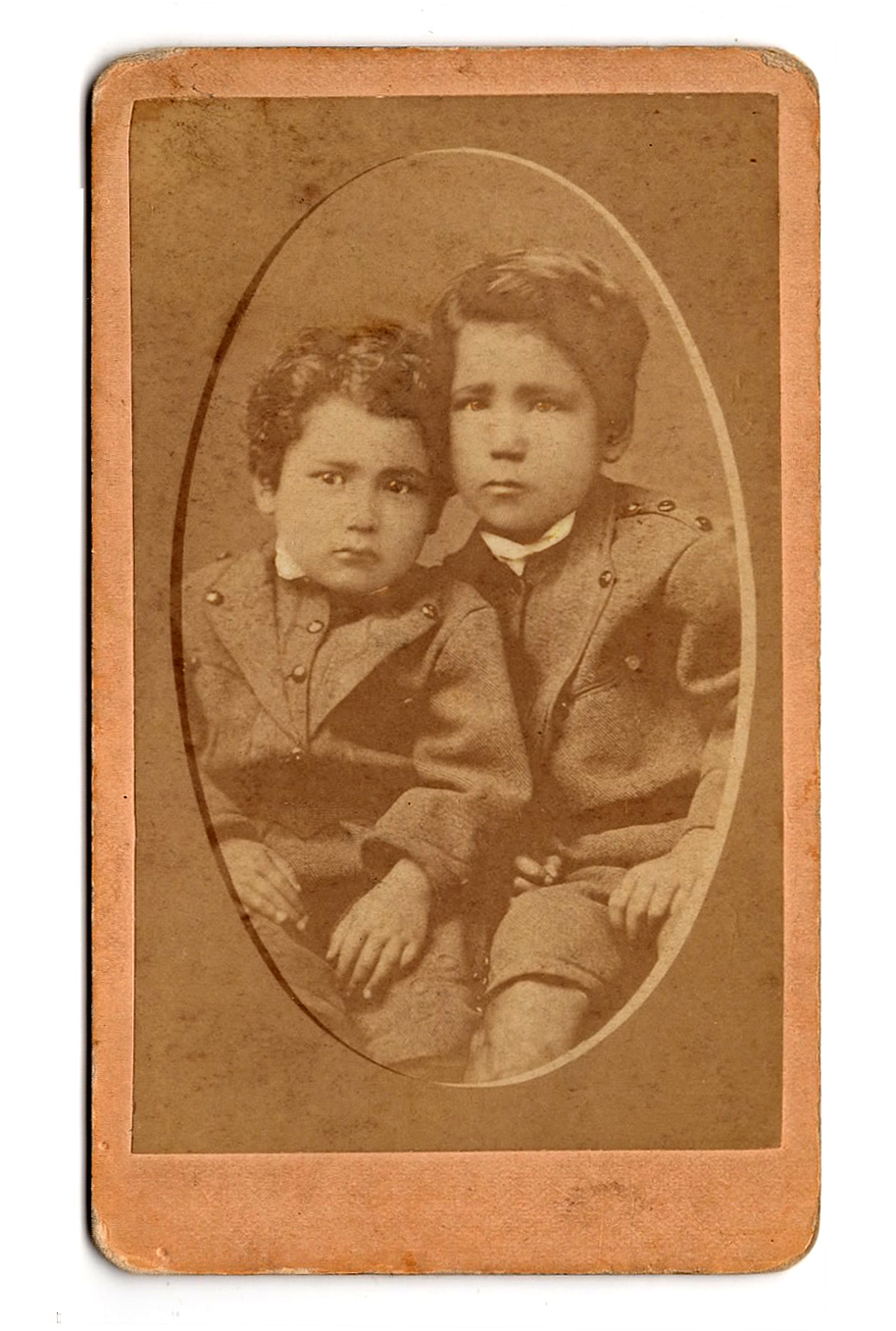
"Who are THESE little boys?", we ask.  

Stella and I are sitting in our long, lost cousin Patrick's Killeen's living room in Pacifica.  It is a special day,  our first visit with him in decades. The sisters are on a mission to recover our ancestors, living and dead.   We are rooting Patrick's pile of inherited famiiy photos. "I have NO idea", he replies.  


 "#@!!??  NO IDEA?", we plead .  


No caption on the backside. No notes....  Still there are clues. These little boys are definitely Latino so that limits them to the Maltos side of Patrick’s family, his other side is clearly Irish.
What else do we know for sure?

* Patrick's family photos were passed down from his grand aunt, Emma Maltos, to his mother Leona Novak then to Patrick. It’s highly likely that these Latino boys in Patrick’s photo box are kids from the Maltos side of the family.  


* The entire box of photos are family. This collection contains no random collector photos. All the memorabilia is restricted to  relatives and their travels. 


 *One of them bears resemblance to slanty eyes of grandpa Juan Maltos.

* It appears that these boys are ages about three and five.  

* Juan Jack Maltos was born in 1869 his brother Antonio Maltos was born in 1871 (following this line of thought would date the picture about 1874...


* Flip the photo and the back shows the photographer is Jacob Shew at 513 Montgomery in San Francisco. 

* More photo research tells us Jacob Shew made his reputation making portraits. He left his mark in San Francisco in the later half of the 19th century.  

Source:  Pioneer Photographers of the Far West:  A Biographical Dictionary, 1840-1865                  

By Peter E. Palmquist, Thomas R. Kailbourn, Page 494.


* The dates fit. The boy's ages are is within the time frame of Jacob Shew’s Photographic studio operation at Montgomery Street.

* Grandma Abata Maltos San Francisco North Beach household was within walking distance to the studio. Not a far jaunt, even for little boys.

We imagine a story like this: Perhaps young Juan and his brother Antonio were visiting Grandma Abata Maltos in San Francisco and they had their picture taken in the studio on Montgomery Street.   We can see a lot of care when into those little boy's small suits. Aunt Antonia (who was also godmother to Antonio and present at his baptism in San Jose) was a seamstress.  It’s easy to imagine she and Abata made those little suits. Some things we know for sure. Some things are a guess... and we imagine the rest.

  Linda Allison July 2015

Viewing the Past


Stella is out walking the dog near St Mary’s Cemetery, Oakland, CA. She emails:

"... I passed by St. Mary's cemetery. Earlier last year I walked the grounds and determined that this is the plot where Francisco Zaravia is buried. I imagine that Abata, Antonia, Angela and Louise may have stood on this very spot on the day they buried him."

Francisco Zaravia, husband of Angela Maltos Acosta, died of angina pectoris or heart failure in April of 1894. He was 34, a shoemaker who had come to California 8 years earlier from Mexico. Angela his young wife was only 21. We feel lucky to possess a portrait of this young couple in their wedding finery. Angela’s dazzling white wedding dress is clearly cut, fitted and sewn by a master dressmaker … very likely Antonia herself.  

I imagine them standing on this hillside on a cool April day. Three widows; Angela now in black, Antonia 39 and widowed nine years earlier, her mother, Abata Maltos now 84 years of age and also a widow and Antonia's 14 year old daughter Louise. This must have been a day of great sadness for the Maltos widows. So much loss.

Today it is the first week of November… the week of All Souls Day. Stella and I share the sense that October and November are months that the spirits of the departed speak the loudest. When they speak we listen. Our grand aunt Antonia Maltos Davis and her kin are missing in the family lore. The search sisters know her only by excavating her records and piecing together the facts of her life from census records and newspaper clips... and trying to imagine what it was like to stand in her shoes.


Friday, November 6, 2015

Antonia Maltos Davis: Dressmaker to the Rich and Infamous


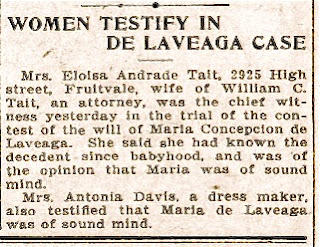
San Francisco Call, Volume 108, Number 71, 10 August 1910


Mrs. Antonia Maltos Davis is called to court in San Francisco to testify.  The question put to Antonia : was the heiress Maria Conception de Laveaga of sound mind? Or was Maria dim, feeble-minded, and deranged?  Our Antonia says she was of sound mind.

The circumstances tell us our dressmaking grand aunt Antonia was a master seamstress.  Maria Conception, her client,  with her multi-million dollar fortune could afford the best. Antonia testifies in her defense. When Antonia spoke in court Maria Conception had already died in Madrid. Her body had been brought home to San Francisco. Her de Laveaga brother and sister were squabbling over who would  inherit her millions. Maria C. spoke mostly Spanish,  her affairs were handled by her brother Miguel. Sister Ignacia, aka. Nacha ran her household. We know the de Laveagas were no strangers to court. A years long battle raged when the de Laveaga family banded together to disinherit Anselmo, their brother's son who was the result of a liason with the housemaid.

What we do know about the De Laveagas is that they migrated from Mexico, from an area around Mazatlan. The De Laveaga patron owned a rancho of many acres on the way to the town of Rosario where the Maltos clan were born.  We know that Antonia's family and Maria Concepcion's families moved north to seek their fortunes in California about the same time.   Antonia becomes dressmaker to the De Laveagas in San Francisco of the 1860's.

Coincidence? More? Perhaps we will never know. 

Apparently the dressmaker's testimony didn't have much effect on the judge.   Judge Coffee after 212 days and 18,000 pages of court testimony deemed the dead daughter Maria Conception De Laveaga impaired and incapable of making her own handwritten will without "undue" influence. Nacha, the big sister and her lawyer husband lose their claim and are forced to split the family fortune with the other relatives.

I wonder if our Antonia, the dressmaker was paid for her time in court?