Sunday, November 8, 2015

Lost Boys? : Juan and Antonio Maltos


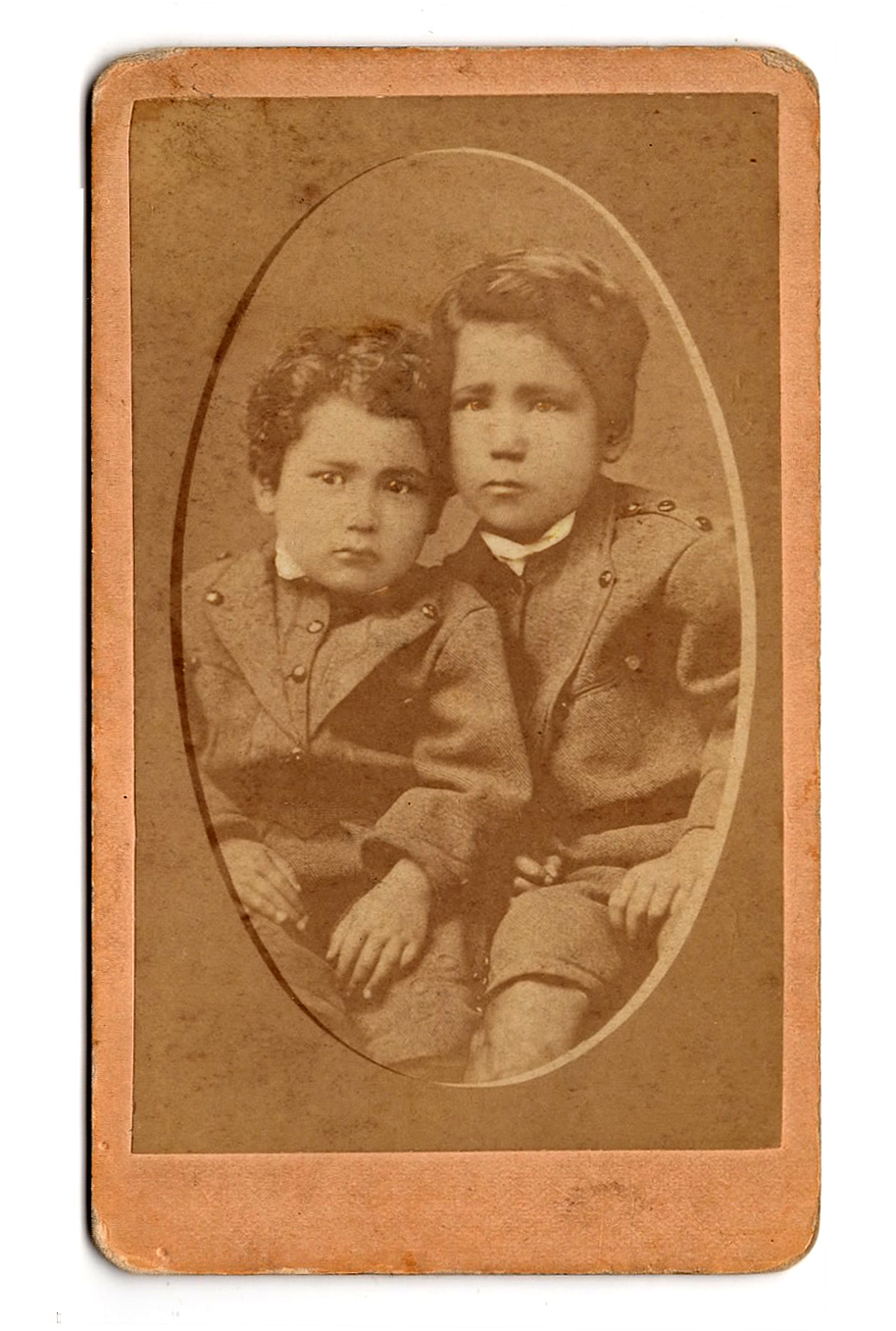
"Who are THESE little boys?", we ask.  

Stella and I are sitting in our long, lost cousin Patrick's Killeen's living room in Pacifica.  It is a special day,  our first visit with him in decades. The sisters are on a mission to recover our ancestors, living and dead.   We are rooting Patrick's pile of inherited famiiy photos. "I have NO idea", he replies.  


 "#@!!??  NO IDEA?", we plead .  


No caption on the backside. No notes....  Still there are clues. These little boys are definitely Latino so that limits them to the Maltos side of Patrick’s family, his other side is clearly Irish.
What else do we know for sure?

* Patrick's family photos were passed down from his grand aunt, Emma Maltos, to his mother Leona Novak then to Patrick. It’s highly likely that these Latino boys in Patrick’s photo box are kids from the Maltos side of the family.  


* The entire box of photos are family. This collection contains no random collector photos. All the memorabilia is restricted to  relatives and their travels. 


 *One of them bears resemblance to slanty eyes of grandpa Juan Maltos.

* It appears that these boys are ages about three and five.  

* Juan Jack Maltos was born in 1869 his brother Antonio Maltos was born in 1871 (following this line of thought would date the picture about 1874...


* Flip the photo and the back shows the photographer is Jacob Shew at 513 Montgomery in San Francisco. 

* More photo research tells us Jacob Shew made his reputation making portraits. He left his mark in San Francisco in the later half of the 19th century.  

Source:  Pioneer Photographers of the Far West:  A Biographical Dictionary, 1840-1865                  

By Peter E. Palmquist, Thomas R. Kailbourn, Page 494.


The dates fit. The boy's ages are is within the time frame of Jacob Shew’s Photographic studio operation at Montgomery Street.

* Grandma Abata Maltos San Francisco North Beach household was within walking distance to the studio. Not a far jaunt, even for little boys.

We imagine a story like this: Perhaps young Juan and his brother Antonio were visiting Grandma Abata Maltos in San Francisco and they had their picture taken in the studio on Montgomery Street.   We can see a lot of care when into those little boy's small suits. Aunt Antonia (who was also godmother to Antonio and present at his baptism in San Jose) was a seamstress.  It’s easy to imagine she and Abata made those little suits. Some things we know for sure. Some things are a guess... and we imagine the rest.

  Linda Allison July 2015

Viewing the Past


Stella is out walking the dog near St Mary’s Cemetery, Oakland, CA. She emails:

"... I passed by St. Mary's cemetery. Earlier last year I walked the grounds and determined that this is the plot where Francisco Zaravia is buried. I imagine that Abata, Antonia, Angela and Louise may have stood on this very spot on the day they buried him."

Francisco Zaravia, husband of Angela Maltos Acosta, died of angina pectoris or heart failure in April of 1894. He was 34, a shoemaker who had come to California 8 years earlier from Mexico. Angela his young wife was only 21. We feel lucky to possess a portrait of this young couple in their wedding finery. Angela’s dazzling white wedding dress is clearly cut, fitted and sewn by a master dressmaker … very likely Antonia herself.  

I imagine them standing on this hillside on a cool April day. Three widows; Angela now in black, Antonia 39 and widowed nine years earlier, her mother, Abata Maltos now 84 years of age and also a widow and Antonia's 14 year old daughter Louise. This must have been a day of great sadness for the Maltos widows. So much loss.

Today it is the first week of November… the week of All Souls Day. Stella and I share the sense that October and November are months that the spirits of the departed speak the loudest. When they speak we listen. Our grand aunt Antonia Maltos Davis and her kin are missing in the family lore. The search sisters know her only by excavating her records and piecing together the facts of her life from census records and newspaper clips... and trying to imagine what it was like to stand in her shoes.


Friday, November 6, 2015

Antonia Maltos Davis: Dressmaker to the Rich and Infamous


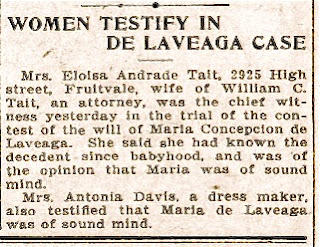
San Francisco Call, Volume 108, Number 71, 10 August 1910


Mrs. Antonia Maltos Davis is called to court in San Francisco to testify.  The question put to Antonia : was the heiress Maria Conception de Laveaga of sound mind? Or was Maria dim, feeble-minded, and deranged?  Our Antonia says she was of sound mind.

The circumstances tell us our dressmaking grand aunt Antonia was a master seamstress.  Maria Conception, her client,  with her multi-million dollar fortune could afford the best. Antonia testifies in her defense. When Antonia spoke in court Maria Conception had already died in Madrid. Her body had been brought home to San Francisco. Her de Laveaga brother and sister were squabbling over who would  inherit her millions. Maria C. spoke mostly Spanish,  her affairs were handled by her brother Miguel. Sister Ignacia, aka. Nacha ran her household. We know the de Laveagas were no strangers to court. A years long battle raged when the de Laveaga family banded together to disinherit Anselmo, their brother's son who was the result of a liason with the housemaid.

What we do know about the De Laveagas is that they migrated from Mexico, from an area around Mazatlan. The De Laveaga patron owned a rancho of many acres on the way to the town of Rosario where the Maltos clan were born.  We know that Antonia's family and Maria Concepcion's families moved north to seek their fortunes in California about the same time.   Antonia becomes dressmaker to the De Laveagas in San Francisco of the 1860's.

Coincidence? More? Perhaps we will never know. 

Apparently the dressmaker's testimony didn't have much effect on the judge.   Judge Coffee after 212 days and 18,000 pages of court testimony deemed the dead daughter Maria Conception De Laveaga impaired and incapable of making her own handwritten will without "undue" influence. Nacha, the big sister and her lawyer husband lose their claim and are forced to split the family fortune with the other relatives.

I wonder if our Antonia, the dressmaker was paid for her time in court?

Tuesday, July 7, 2015

The Name Game: Antonia Maltos Craig Davis


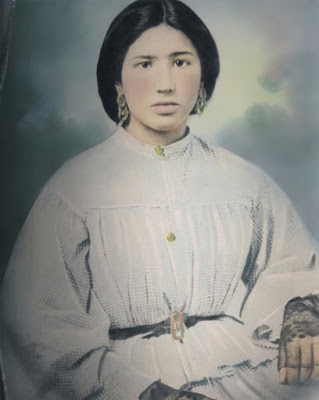
How do you put a name to an unknown face?

1. First you curse the previous owner of the image for not putting an identifying note on the back of the photo. 
2.Then add up the facts you know about the picture.
3. Now take your best guess based on the gathered facts. 

Here is what we know about this picture:

* This young woman’s portrait is one of a pair with the Jose Maria Maltos portrait it has the same treatment with the same frame. 
* Notes on the back Jose Maria image (a different print) say "take care of papa" it is written by his grand daughter Emma Maltos" We have a positive identity for his picture. 
* The hair and costume of the young woman is in the style of the 1860-70s. 
* Jose Maria did not marry until around 1868.  His bride Senona Diaz Luna de Luera was a widow in her thirties. The woman in this picture is younger.  So we are fairly certain it is not Senona.
 * What woman of importance to Jose Maria existed at this moment?  Another wife? We find no record of a previous marriage.  

Our best guess is this is his younger sister, Antonia, photographed sometime in the mid 1860s. We know Antonia was important to Jose Maria. He named his second son Antonio after his sister.  When Antonia came the California the census information tells us she was about sixteen. The girl in the photo is just about the right age. While we have no direct proof of this madam's identity, our intuition tells us this is Antonia. 

  
Linda Allison July 2015

Thursday, July 2, 2015

A Seamstress in San Francisco


We believe this is young Antonia Maltos circa 1868
Antonia Maltos was our great grand aunt. Born in Mexico around 1849, she was the sister of our great grandfather, Jose Maria Maltos. His christening on 9 October 1838 is registered in the baptisms at the cathedral of Nuestra Senora de Rosario in El Rosario, Sinaloa, Mexico. We are still searching for Antonia’s baptismal records. 

El Rosario was a colonial silver mining town. Nearby Mazatlan served as the port from which Mexican miners looking for jobs in California would depart. It is likely that the need for skilled miners in California and the volatile political climate of Mexico motivated the Maltos family to leave their country. According to their reports in the 1900 U.S, census, both Antonia and Jose Maria arrived in San Francisco in 1865 probably with their mother Maria Abata Maltos born 1805. Antonia was nearly 16 years old. Jose Maria, age 27, went to work in the quicksilver mines of New Almaden, a bustling company town in the Santa Clara hills south of San Jose. He soon married to raise 8 children in Spanish Town, New Almaden with his wife, Senona Diaz Luna de Luera born 1836 in Mexico.


Antonia and her mother appear to have remained in San Francisco making their new lives in what we now know as North Beach, a predominately Mexican neighborhood at the time. In July of 1871 Antonia, now a young woman, traveled the 65 miles from North Beach to New Almaden to become godmother to her nephew and namesake Antonio Maltos. San Jose could be reached by the SF&SJ railroad, a three and a half hour trip. The remaining 16 miles to New Almaden’s Spanish Town was a lurching ride by stagecoach.


 In this portrait made at Jacob Shew’s San Francisco Studio circa 1875, Antonia’s young nephews, Antonio and Juan Maltos are dressed in beautifully tailored wool suits. We like to imagine Antonia stitched those tiny outfits for the little boys. 
The 1877 San Francisco city directory shows that 28 year old Antonia lived with her mother at 1716 Stockton Street, a few blocks from the very heart of the Barbary Coast. History tells us theirs was a lively and sometimes dangerous neighborhood. Antonia and her mother probably heard mass in Spanish at the newly established Nuestra Senora de Guadalupe Catholic Church on the corner of Broadway and Mason. 

Antonia’s profession was “seamstress.” Women who did this work earned wages hand stitching simple garments such as skirts, nightgowns and undergarments. As fashion went, San Francisco was no Paris. In 1860 writer, Ada Clare, described the city’s costumes in this way ”It is hard to tell what are the exact fashions here. Dresses are worn of every kind of stuff….and made in every conceivable way.” For a middle class woman it was quite common to have an out-of-fashion dress, often of silk, made into a more up-to-date one. We imagine that over time Antonia became skilled in transforming old garments as well as constructing from new materials. The new, less voluminous, dress styles of the 1880s made it possible to refashion an en vogue dress from the ample yardage of an old dress. What we now call “upcycling” was a way to find fabric in a city that imported new materials from around the Horn.


By 1880 Antonia had married and she and her husband, Mexican born Louis Davis, ran a grocery store at 720 Broadway. A few years later their daughter, Louise, was born. When, sadly, in 1885 her husband died, Antonia continued to work as a grocer. After a few years she and her mother relocated to 1006 Pacific St. It seems likely that as a widow with a toddler and an aged mother Antonia remained close to home returning to the trade which she had honed before her marriage. The 1888 San Francisco city directory lists Antonia   now a “dressmaker”, a distinction which indicates she was able make patterns and offer custom work with more sophisticated skills than those of a seamstress.


As a dressmaker, the young widow’s income would have increased by 2 or 3 times that of a seamstress.  Many seamstresses fitted clients in their homes and brought the garments back to be sewn at night. Fitting was a fine art, and the styles of the times demanded serious fitting skills and attention to detail. Antonia’s role as a dressmaker allowed her access to the homes and lives of her clients and the news of the neighborhood and could provide lots to talk about while the Maltos women stitched at night. 


Antonia’s niece, Angela Acosta Zaravia born 1873 in Mexico, stands for the photographer in her perfectly fitted day dress the tailoring and detail of which rival the skill and labor required to make a man’s suit. 

Angela Acosta Zaravia, and her husband Francisco Zaravia pose in their wedding finery (circa 1890). Antonia and Angela were close and it seems likely that Antonia fitted and crafted this lovely gown.
  
By 1900 Antonia’s mother, Maria Abata, had died.  Antonia continued working as a dressmaker and her 17 year old daughter Louise was a telephone operator. Living with them was Antonia’s recently widowed niece, 29 year old Angela Acosta Zaravia who just five years later would succumb to heart disease.

On April 18, 1906 Antonia and her daughter Louise were awakened by the Great Earthquake. They were jolted from their beds at 1018 Clay Street, a few blocks from the site of one of Arnold Wenthe’s famous Great Earthquake photos. They survived. Though the destruction of their home sent them out of the heart of the city and away from the Spanish speaking neighborhood which was their first home in California to live on the Avenues.

Did Antonia continue her sewing career out on the Avenues? Who wore her clothes? Did she ever own a sewing machine?  

Oddly, when my sister and I first came to live in the San Francisco bay area, we too made money by sewing  clothing.  Years later we were shocked to find we had ancestors that lived their lives in North Beach. Then we knew nothing of these latina ladies who supported themselves with needle and thread. We had no direct stories, no photos and no artifacts from Antonia, Abata, Angela or Louise. Our great grandfather’s name and occupation, Jose Maria Maltos, a miner from New Almaden, were our only known facts.  The scraps of facts, the threads of history that we have discovered have come together to weave this story of Antonia and her Maltos family. 


Antonia died 20 December 1930 at the age of 81. Her daughter Louise appears to have lived the rest of her life in San Francisco and never married. Antonia is buried at Holy Cross Cemetery beside her mother Maria Abata Maltos, daughter Louise Davis and niece Angela Acosta Zaravia.  


We continue to search for more bits and pieces to help us understand the fabric of these women’s lives as seamstresses in the city of San Francisco. 

Stella Allison, July 2015 


Sources: Photos from the collections of Patrick Killeen and Lori Johnson

Ada Clare, About Fashions, found in No Rooms of Their Own: Women Writers of  Early California 1849=1869, Ida Rae Egli


Sunday, May 3, 2015

Veronica Knows ...


Senona Luna Luera Maltos, Gomecindo's Widow
photo circa 1900

 " I can tell you what happened to widows - the mine would assign an unmarried miner to live with her so she could earn room and board money.  He often became the next husband. They also took in laundry for unmarried miners.  Sometimes they would be lucky and have a widowed father to live with or a son old enough to work and support her and the younger kids.  You can see the story on the census records, showing boys as young as 14 working in the mine.  All of these scenarios happened in my families."


Veronica
  
Veronica Jordan is our go to girl in all things New Almaden. We were first introduced to her by Mary Hanel, the librarian at County Library History Room, on our first excursion Santa Clara. Veronica had to cancel our meet-up at the last minute, but we were assured that she knew a LOT about Almaden.

So true.  Veronica knows where all the bodies are buried.  She uncovered the Gomecindo Luera murder in the newspaper and tied him to our tree.  She is a crack researcher who has exceptional ability to source the really juicy stories, particularly when it comes to newspapers.


In addition, Veronica has deep knowledge of the families of New Almaden. As a child she visited her grandparents in New Almaden. Some of her kin still live in the area. We have discovered that her tree runs parallel to ours with some common families Avila, Sambrano, Paredes, Selaya.  Veronica holds the characters of the village of Almaden in decades past her head, and can make connections like no one else. 


Veronica is a great detective with the ability to put the pieces together. Best of all she is enthusiastic and lots of fun.  


Thanks Veronica, for being such a great Search Sister.


Friday, May 1, 2015

Gomecindo Luera's Widow

Alas, lost Gomecindo.  Vanished one winter evening in 1866 from Spanish Town in New Almaden  . The San Jose paper reports in 1885, " his wife never saw him again and refused to believe he had deserted her."   

Twenty years later Gomecindo found, deep in the New Almaden mecury mine with a bullet hole in his skull. 
Source: Cinnabar Hills, The Quicksilver Days of New Almaden, Lanyon and Bulmore
 What did Senona do while waiting for Gomecindo to come home those months after he disappeared in 1866?  She and her baby daughter Mary Reymunda Luera lived in a company town in a miner's cottage. It is not likely that the New Almaden Quicksilver Mining Company  was willing to support a woman whose husband had abandoned his wife and job.    Senona Luna de Luera, no doubt had to scramble to make a way for her tiny daughter and herself in a town of miners. What could she do?

Maria Senona Diaz Luna Luera got herself a new husband, Jose Maria Maltos. How this happened we will never know. In the year Gomecindo's body discovered the 1870 census records show she was living with Jose Maria in a miner's housing in New Almaden's Spanish Town.  By that time Jose Maria Maltos and Senona had produced seven children, our grandpa Juan Maltos among them.

If Gomecindo hadn't taken a bullet in the head, would we exist? 

Perhaps Gomecindo's tragedy was our lucky shot.